Dynaudio Contour 20 Speakers I
There’s an easy – but wrong-headed – dismissal of Dynaudio as just a safe pair of musical hands. The notion is understandable: the company makes very well-built loudspeakers with a significant amount of objective test and measurement in the design process, and they are created to work with the maximum amount of possible combinations of upstream electronics. Dynaudio’s styling is conservative, too.
All of which also makes it easy for someone to dismiss Dynaudio by calling on a product from a quarter of a century ago. The Dynaudio Contour 30 floorstander ably demonstrates why that kind of lazy criticism is wrong.The Contour 30 is a tall, slim, deceptively heavy floorstander, beautifully finished with curved front and rear panels that yield an elegant one-piece look. The gloss white of the review pair, or any of the five other finishes is offset by a curved contrasting aluminium 14mm thick baffle (silvery grey-white in the white models, matt black in the black and tree-coloured models). There is also a matching grille, which is magnetically attached, but only reaches down to the Dynaudio logo on the front baffle – this gives a three-tiered appearance (cabinet, baffle, grille) that looks good, but is the one deviation from the otherwise minimalist, clean lines.
There’s a standmount Contour 20 and a larger Contour 60 tower in the range.This Contour 30 model is a two-and-a-half-way, rear-ported design, with the company’s latest 28mm Esotar2 tweeter (back when Dynaudio used to sell drive units to speaker builders, the Esotar tweeter was the one you saved up for, because the soft-dome fabric tweeter sounded more effortless, more clear-sounding, and more ‘right’ than its rivals, and the Esotar2 only builds on those properties). This tweeter is joined by a pair of new 18W55 180mm MSP cones, with doubled magnets, a longer aluminium voice coil, and thinner cone material than previous models. This is met with a high-grade crossover network bristling with Mundorf caps and air-cored inductors.In most speakers, that would be enough. You could stuff those elements in a fairly ‘blah’ box and get a good sound. Not Dynaudio, though. The ‘deceptively heavy’ bit is the asymmetric use of MDF across the cabinet. The front, top, and bottom are 26mm thick, the rear is 38mm thick, and the side panels are 16mm thick.
These are further strengthened with MDF bracing near each driver, and an internal acoustic treatment called KERF. Sounding a little like an obscure sport (“Yay! We won Olympic Bronze in the Mixed Kerfing”), the KERF-cut is a series of MDF diffraction strips running along the internal side walls of the Contour 30’s cabinet, designed to reduce the influence of standing waves. The cabinet is filled with three kinds of acoustic absoption.
According to Dynaudio, each cabinet takes over 90 minutes to turn on a five-axis CNC machine, the lacquering process takes 40 hours to cure, and 16 pieces of sandpaper make the ultimate sacrifice in order to finish the speaker to Dynaudio’s standard.A set of outrigger feet and the single-wired multi-way terminals seal the deal. Except they don’t: Dynaudio discovered that the performance of the Contour 30 was improved by a new set of high-grade feet, both supplied as standard to new customers and available for free to existing Contour 30 owners. They make a big difference, too. I like the fact the company didn’t just sign off the design, but updated it – even something as seemingly trivial as feet – but I really like that this is a free retrofit for all existing owners. That is all existing owners who feel inclined to heft these loudspeakers off their current perch.The Contour 30 is not a difficult loudspeaker to drive, although an 87dB sensitivity, a four-ohm minimum impedance, and 300W power handling all suggest use of a meaty, high-performance amplifier. I used it with effortless ease with a Naim Uniti Nova (although I think further up the Naim range will help), and it also performed perfectly well with the D’Agostino pre/power combination tested on page 20.
Dynaudio Contour 60 Speakers Review
The loudspeaker isn’t cable fussy and doesn’t make too heavy demands on the user in terms of installation or room treatment; just follow the manual. The speakers are best used away from the rear wall (I think about a metre is a good starting place) and ideally about a metre from the side walls. That being said, the more you put in, the more you get out in installation terms. OK, so there isn’t a £20,000 loudspeaker lurking inside the box waiting for the magic installation to let it out, but following good first principles of levelling, position, toe-in, and the rest of the general housekeeping that applies to loudspeakers makes a big difference.

We’ve reviewed some pretty clever speakers over the past few years. Sensitivity 86dB (2.83V/ 1m)IEC power handling 180WNominal impedance 4 ohmsFrequency response 39Hz-23kHz (-3dB)Box principle Rear-ported bass reflexCrossover 2 wayCrossover frequency 2200 HzCrossover slope 2nd orderWoofer 18cm MSP coneTweeter 28mm soft domeWeight 15.5 kgDimensions (hwd) 44 x 21.5 x 36cmWe have never doubted Dynaudio’s ability to design drive units. Its designs have featured on some of the finest speakers ever made (on an OEM basis), and the drivers used on the Contour 20 are terrific. It’s just a shame that, visually at least, there’s little to separate these exotic premium units from those used in the company’s entry-level Emit range.The diaphragm materials appear much the same too – fabric for the 28mm soft-dome tweeter and MSP (Magnesium Silicate Polymer) cone for the 18cm mid/bass. You’ll find the differences behind the headlines, in things like the motor system, the suspension and more ambitious detail engineering that separates the good from the great.Equally, that 44cm tall cabinet looks entirely conventional, but it isn’t. Like most rivals it uses MDF, but here the back panel is 38mm thick and is coupled to 16mm sides.
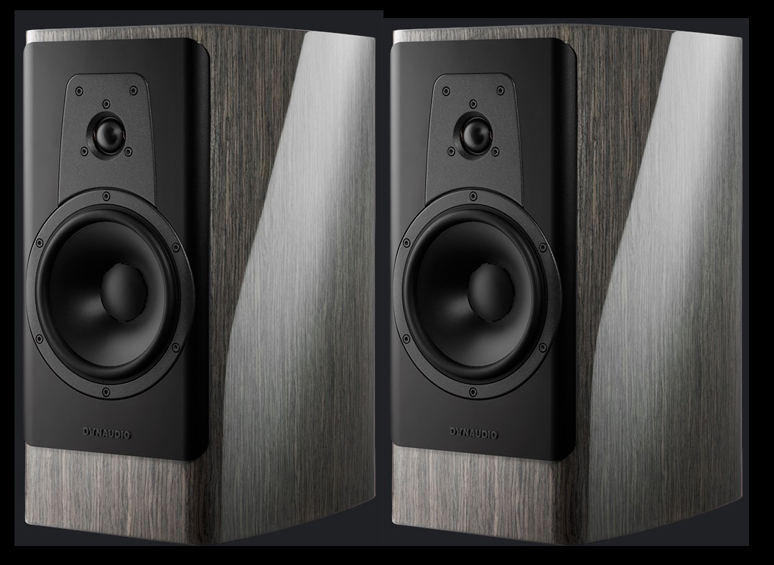
There’s extensive bracing to control resonances and improve stiffness. That front is a mix of a 14mm aluminium panel lined with 16mm MDF – a combination that results in a rigid and well-damped platform for the drive units to work from.Our review samples are finished with a traditional walnut veneer, but if this doesn’t appeal there's also ivory oak for the same price or white and black gloss options for a 10 per cent premium. There are two other choices – gloss grey oak and dark rosewood – both of which look lovely, but add 15 per cent to the price.
The speakers are rear ported, so take care with positioning Performance and positioningThe enclosure is rear ported. This means that a little care needs to be taken in positioning.
The 20s sound most balanced around a metre in to our listening room and with just a small degree of angle towards the listening position. Set up this way, they produce a wide and precisely focused soundstage coupled with a pleasing amount of weight and authority.If you need to place the speakers closer to a wall, don’t worry. Dynaudio provides a two-stage foam port bung that blocks the port to varying degrees. Using these bungs gives you a chance to control the speaker’s low frequency output to a degree. In our room we preferred the sound with ports open.Any good speaker at this level will need to be partnered with capable electronics to really shine, and these Dynaudios are no different. We use our usual reference system, comprising music streamer, turntable/Cyrus Phono signature vinyl combination and pre/power. The Contour 20s sound assured, solid and stableSound qualityOur first impression is of an authoritative and composed performer, one that sounds in control no matter how complex or demanding the recording gets.
It’s an impression that stays with us throughout the test process.We start off with Vivaldi’s Four Seasons and the sheer scale and dynamic reach of the Contours stand out. The speakers sound assured and solid, with a stability of presentation that impresses. Detail levels are high; the Dynaudios digging deep into the fabric of the recording and revealing low-level details most rivals would ignore.Things are good tonally. The Contours have a smooth, refined balance that avoids emphasising the harshness in aggressive recordings.
Bass is rich but remains articulate, and is surprisingly extended for a speaker of this size. With eyes closed, it would be easy to imagine the sound coming from the 20s to be that from decently sized floorstanders. Gloss grey oak finish adds 15 per cent to the priceDynamics are delivered with enthusiasm. Given a capable amplifier these speakers don’t hold back. They paint on a large canvas and render dynamic extremes with confidence and punch. Pleasingly, they don’t overlook the subtleties and handle nuances with care.We move to The xx’s debut set and the Dynaudios revel in the complex rhythms and sparse production. The 20s don’t hold back when it comes to rhythmic expression and manage to render instruments across the frequency range in a musically cohesive and satisfying way.
Dynaudio Contour 30
Put simply, these are a fun listen.The care taken in the crossover design and matching of drive units shines through in the Contours’ fine integration and the seamless midrange performance. Voices are rendered with passion and are delivered with force and finesse depending on the quality the music demands. Add plenty of attack and you have speakers that are at home with all types of music. VerdictDespite first impressions we find ourselves deeply impressed with the things these standmounters can do. It looks like the old saying about judging a book by its cover applies to hi-fi too.SCORES. Sound 5.
Dynaudio Contour Speakers
Compatibility 5. Build 5Also consider.