Denver Developmental Screening Test
Soal lcc tingkat sd. You have two horses. Complete the following sentence with correct form of possessive pronouns.
Developmental Screening test 000b (Denver II - Overview).1.Historical Background. Denver II (1992) Previously the DenverDevelopmental Screening test, DDST (1967). Used by health providers to identifydevelopmental problems in young children. Has been used and standardized in over 12countries.
Printable Denver Developmental Screening Test
Results:Most of the children (24, 68.6%) had test results compatible with normal development, while 10 (28.6%) had a “risk” test and 1 (2.9%) was “untestable” due to refusal to carry out the proposed activities. As to the items evaluated in each area, 7 children (20%) showed a developmental “delay” (when the child does not perform the activity passed by more than 90% of the children of his/her age) and 18 (51%) required “attention” (when the child does not perform the activity passed by 75 to 90% of the children of his/her age), predominantly in the language area. Conclusions:Although most of the children (68.6%) presented normal development in the test, we point out that in the remaining children (31.4%), the number of items classified as “delay” or “attention”, and tests classified as “risk” or “untestable” suggest impairment in neuropsychomotor development. We underscore the importance of the routine administration of the DDST-R for an early detection of developmental disabilities and thus establish primary prevention programs.Keywords: Child development; Primary health care; Developmental disabilities. RESULTSThe development of the majority of the children assessed (24; 68.5%) was compatible with their age range; the tests of 10 children (28.6%) was classified as “risk”, and only 1 (2.9%) was “untestable”.Initially considering the number of children with “delays”, in a total of seven, we verified that these delays were more frequent in the “fine motor adaptive” category (3; 42%), followed by the “personal-social” (2; 28.6%) and “language” (2; 28.6%) categories. As for the number of delays identified, in a total of 10, half (5; 50%) occurred in the language area.
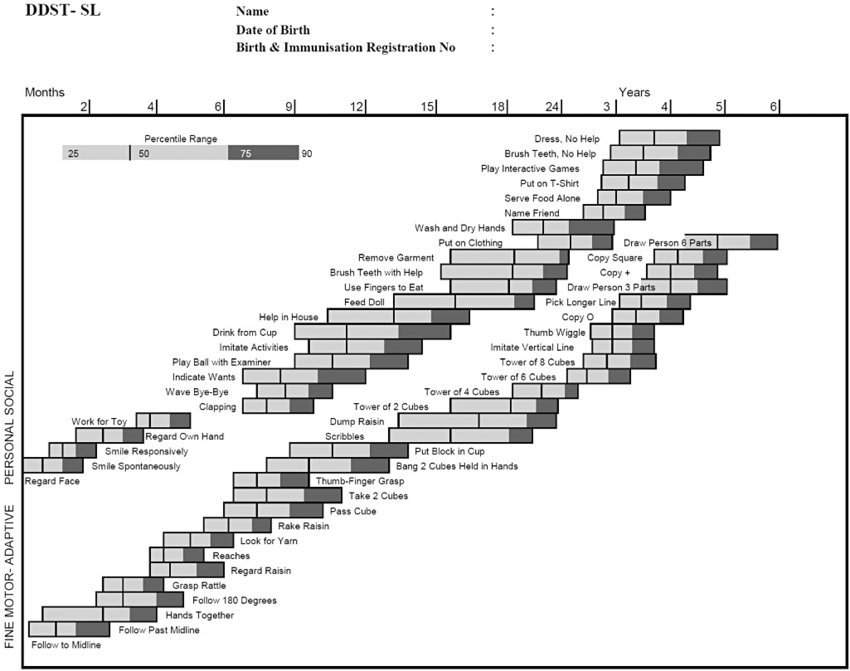
Denver Developmental Screening Test Spanish
Areas/categoriesChildren presenting “attention”Test items identified as “attention”n%n%Personal-social633.3733.3Fine motor adaptative527.8523.8Language738.9942.9Gross motor-Total.Attention occurs when the child does not perform or refuses to perform an activity that is conducted by 75 to 90% of children at the same age.In relation to the only child (2.9%) who refused to perform some items of the test, we observed a slight predominance in items of the language area (2; 50%), as shown in. CONCLUSIONSIn view of the results, we concluded that the majority of the children showed normal development; 1/4 had a “risk” test, and only 1 child was “untestable”. The highest number of items pointing to “delays” or “attention” among the activities performed by the children occurred in the language area.Considering the number of children with “delays” or “attention”, the language area had a high prevalence of “attention” items, whereas more children showed “delays” in the fine motor adaptive area.