Property Node Gui Labview
Closing References in LabVIEWWhen you open a reference to an application, project, VI, or other reference source, LabVIEW allocates memory to store that reference. To free up the space in memory where LabVIEW stored the reference source, you must close the reference. It is always safe to close a reference when you no longer need it. You can use the Close Reference function (linked below) to close a reference. VI Server ReferencesVI Server references are reference types found under the Select Class»VI Server shortcut menu item that appears when you right-click a property or invoke node, as shown in the following block diagram.
VI Server references include references to applications, projects, libraries, controls, VIs, and so on.Knowing when to close a VI Server reference and when you can safely leave a reference open can be difficult. However, unless you are certain you can safely leave a reference open, always close references when you no longer need them.
Reference FunctionsIf you open a reference using an Open VI Reference function, New VI function, or similar function, LabVIEW creates a new reference every time LabVIEW calls the referenced VI. Close these references each time you open them to avoid creating additional memory allocations for each reference. Multiple Calls to Property and Invoke NodesWhen LabVIEW calls a Property or Invoke Node multiple times, LabVIEW does not provide any method for checking whether LabVIEW returns the exact same reference for each call or allocates a new reference for each call. In the following example, LabVIEW calls a Property Node multiple times, but provides no way of knowing whether the property will return the same reference each time LabVIEW calls it.Because you cannot be sure that LabVIEW does not create a new reference allocation for each call, close these references, as shown in the following block diagram, to avoid any potential reference leaks.Reference LeaksIf you do not close a reference, your application is susceptible to reference leaks that can use up memory and slow the execution time of the application.
LabVIEW is a graphical programming interface which can be used to communicate with any Thorlabs Kinesis ®-compatible controller through the use of component Kinesis.NET controls. These.NET controls are a part of the.This tutorial contains annotated LabVIEW VI examples for interfacing with Thorlabs’ Kinesis software. These examples make use of the Controls.dll file included with the Kinesis software installation package. This dynamic link library (DLL) assembly includes a collection of WinForms controls that hosts the Kinesis User Interface elements and underlying device functionality. These controls provide a straightforward way to start working with Thorlabs’ Kinesis software in LabVIEW.
Section Tab Contents:. LabVIEW: Overview of Basic Information to Consider When Using Kinesis with LabVIEW.
Getting Started: Instructions on Software Installation Prior to Using the Example VIs. Example VIs: Sample Code for a Selection of Thorlabs Controllers. DLLs: Information on Loading Additional DLLs for Increased Functionality. Other Programs: Tutorial and Sample Code for Interfacing Kinesis with C#A comprehensive guide to using Kinesis with LabVIEW can be downloaded or by clicking the button to the right. It provides step-by-step instructions to create a custom Kinesis.NET control VI in LabVIEW. Figure 3: For Multi-Channel Device Types, the ‘Channel Number’ Property Must BeAssigned in the Block Diagram to Correctly Initialize Each Device Channel LabVIEWLabVIEW can be used to communicate with any Thorlabs Kinesis ® compatible controller via Kinesis.NET dlls. Of the numerous dynamic link libraries (.dlls) included, the ‘Controls.dll’ provides a collection of.NET WinForms User Controls which can host the device user interface (UI) elements and provide access to the device methods and properties.For example, the Kinesis graphical user interface (GUI) for the KDC101 K-Cube DC Servo controller is shown in Figure 1.
This ‘View’ (UI), as seen in the Kinesis.exe application, can be hosted in the LabVIEW front panel, while providing the user access to back-end Kinesis.NET methods and properties in the LabVIEW block diagram.By inserting the.NET ‘Controls.dll’ into the LabVIEW front panel, the user will be able to load a user interface for any Kinesis compatible device. Considering the example of a KDC101 K-Cube DC Servo controller, this device UI can be initialized by providing the serial number of the device and selecting CreateDevice, as illustrated in Figure 2. This will create the device connection and display the UI seen in Figure 1.Controllers that have a multi-channel architecture, such as the BSC202 Benchtop Controller and the MPZ601 Rack Module Controller, must also have the Channel Number specified. In the example shown in Figure 3, two separate UI panels are created (one for each channel) which can be operated independently of one another.A range of downloadable, annotated example VIs can be found in the Example Vis tab.
The examples provided are related to specific controllers and are organized by hardware type (i.e. Motor, Piezo and Piezo Motor, and Strain Gauge Reader). A Simulator VI is also provided which will enable connection to the Kinesis Simulator Application. The examples are saved as LabVIEW 2012 compatible examples.For tips on building your own VIs with Thorlabs Motion Control Hardware, please see our comprehensive.For any questions or comments about these examples, please contact. Figure 4: Insert the.NET Container into theLabVIEW Front Panel Inserting a.NET Control. Right-click on the front panel, then select '.NET container' and place the container on the front panel (Figure 4).
Right-click on the.NET container and select 'Insert.NET control.' .
Disable Property Node Labview
In the 'Select.NET Control' window, click 'Browse.' . Browse for and select 'Thorlabs.MotionControl.Controls.dll', located in the user's LabVIEW project folder. In the 'Controls' list, select the controller that will be used (Figure 5). The LabVIEW front panel will now display the Kinesis device's user interface (Figure 6). The device methods and properties can now be accessed via the block diagram. Please note that the device UI will appear as ‘Disconnected’ until the VI is running and the control has been initialized.
Figure 9: Insert Properties andMethods via the Functions Palette Accessing a Property or MethodThe Control reference node provides access to the Control methods and properties, such as CreateDevice and CloseDevice. Right-clicking the node will enable you to initialize or close communications with the device.
CloseDevice will close communications, shut down the.NET library, and reset the UI when the session terminates.The Device methods and properties can be accessed through the Device property reference, as shown in Figure 7. In the case of T-cube and K-cube type devices, this property is 'Device'. In the case of Rack Module and Benchtop type hardware, device properties and methods can be accessed from the device type specific property label, i.e. 'ModularPiezo' or 'BenchtopStepperMotor', as shown in Figure 8.Alternatively, LabVIEW.NET connectivity functions allow you to create and interact with the Kinesis.NET SDK. Through the Functions Palette, select 'Connectivity.NET' to access all functions used to interact with.NET objects (Figure 9).For more information on LabVIEW.NET connectivity, please refer to the. Figure 10: Register Events Such as MotorStateUpdate in the Front Panel Working with EventsAn Event Callback VI is created using the Register Event Callback Function in LabVIEW. This will cause a VI to be called under specified conditions.
Some basic events include Motor Status Updates (Figure 10), Connection Change Events, Settings Update Events, or Error Update Events. These events are detailed further in the Kinesis.NET API. An example of this is provided in the KDC101 Motor Status Changed tutorial where a programmed response appears when the Motor State changes. The Kinesis DLLs (such as those contained in the partial list above) must be copied into your LabVIEW project folder. Getting StartedComplete the following steps before using the example virtual instruments in the Example VIs tab:.
Install the. Ensure that the version of Kinesis/component DLLs is of the correct bit type, depending on the version of LabVIEW and the operating system. The included examples were built using Thorlabs' Motion Control Software v1.14.12.
For the example VIs to run successfully, manually copy the component DLLs from the Kinesis install folder to the “Kinesis LabVIEW Examples” folder. The Controls.dll will typically require all Kinesis DLLs to be copied into the project folder. Open the VI through the 'LabVIEW Project Explorer' to correctly load the User Interface from the Thorlabs.MotionControl.Controls.dll.Example VIs - Front Panel OverviewA LabVIEW VI contains two windows for building applications; a Front Panel and Block Diagram.
Property Node Gui Labview Tutorial
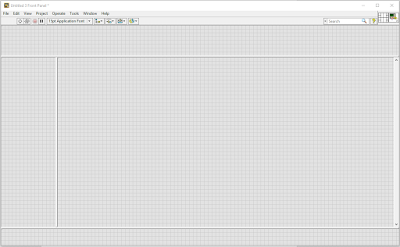
The LabVIEW Front Panel contains the front end User Interface components of the VI. The Front Panel of each Example VI has been formatted to contain instructions and features which make these VIs easy-to-use. An overview of these features along with some of the key interface features of the LabVIEW Front Panel are outlined below.Legend:. LabVIEW Toolbar, Where the VI is Run. Name of Device the Example Utilizes, Along with Webpage Link. Introduction and Step-by-Step Instructions for the Example VI.
Functioning Front Panel Controls and Indicators (Please note that the device UI will appear as ‘Disconnected’ until the your VI is running and the control has been initialized.). Tips to Consider When Running the Example VI. Example VIsItem #, TypeExample NameDescriptionMotor ControllersK-Cube, Brushed DC ServoBuild Device ListThe example VIs require you to enter the serial number of your device manually. This VI, however, will build a list of connected devices and wait until the user has selected the serialized device to control.ConnectDemonstrates how to initialize communication with and then disconnect from the KDC101 in order to control DC brushed stages and actuators.Get PositionGet Position will poll the device position through the GetPositionCounter method which will output the stage position in device units. This can be converted from device units (encoder counts) to real world units (mm) by considering encoder counts per revolution of the motor, gearbox ratios and leadscrew pitch.Motor Status ChangedThis VI enables you to make use of motor events. These events include motor status updates, connection change events, settings update events, and error update events.
This VI utilizes the motor status update. An event callback sub-VI is built using the register event callback function in LabVIEW.Move AbsoluteThis VI will allow you to home the device and move it to a chosen position.No Front PanelThis VI shows how to communicate with Thorlabs Motion Control devices outside of the provided WinForms UI controls contained in the Thorlabs.MotionControl.Controls.dll.
This VI focuses on the wider range of generic and device-specific component DLLs included with your Kinesis installation.K-Cube, Brushless DC ServoGet Status BitsThis VI will poll status bits through use of the GetStatusBits method.Set Trigger ParametersEnables exploration of the trigger parameters available to all Thorlabs K-Cube devices.Set Velocity ParametersThis VI monitors and sets the current velocity parameters of the connected device.Benchtop, Brushless DC ServoTwo-Axis ScanThis VI will perform a 2D square raster scan, moving in a forward direction from a user defined start position. The user can set the number of steps and step size, as well as how long the stage rests at a scanned position.K-Cube, StepperMove RelativeThis VI allows homing of the device and moving forward (clockwise) or backward (counterclockwise) at any valid distance from the homing position.Piezo / Piezo Motor ControllersK-Cube, Piezo ControllerConnectDemonstrates how to connect with and disconnect from the KPZ101 Piezo Controller.Waveform LUTEnables use of the LUTWave functionality available to piezo-actuated devices not included within the Controls.dll.
Taking advantage of the built-in Sine Waveform.VI of LabVIEW, the device can output a sine waveform with a scalable amplitude. Details of this functionality are outlined in the LUTWaveParams structure within the.NET API.w/K-Cube, Piezo Controller and Strain Gauge ReaderSet PositionDemonstrates open- and closed-loop operation of the KPZ101 Piezo controller when used with the KSG101 Strain Gauge controller. When in open-loop mode, the user can adjust the voltage of the piezo stack.
Property Node Gui Labview Code
When in closed-loop mode, the position can be set by using the SetPercentageTravel function.Benchtop, 1 Channel Piezo ControllerConnectDemonstrates how to connect with and then disconnect from the BPC301 controller.Waveform LUTEnables use of the LUTWave functionality available to piezo-actuated devices not included within the Controls.dll. Taking advantage of the built-in Sine Waveform.VI of LabVIEW, the device can output a sine waveform with a scalable amplitude. Details of this functionality are outlined in the LUTWaveParams structure within the.NET API.Benchtop, 3 Channel Piezo ControllerTwo-Axis ScanPerform a 2D square raster scan for pre-selected channels on a BPC303 unit. This VI also includes the error handling cluster, which prints error messages and their corresponding codes.Rack, Modular 2 Channel Piezo ControllerConnectDemonstrates how to connect to and safely disconnect from the MPZ601 controller.PPC001, PPC102 aBenchtop, Precision Piezo ControllerContinuous ScanThis VI will enable you to connect to devices and linearly increment the piezo position at a user specified delay and step size.
This VI will step the stage forward 5000 steps, and then backward 5000 steps. While the focus of this tutorial is using the WinForms User Controls library (Controls.dll) as a straightforward way to load a UI panel and utilize Thorlabs' Kinesis hardware, it is possible to access the more advanced functionality contained within other.NET DLLs included with the Kinesis software installation. This functionality is outlined in detail within the Kinesis.NET API help file.The following examples from the Example Vis tab make use of functionality outside of the Controls.dll library:. KDC101 - No Front Panel.
BPC301 - Waveform LUT. KPZ101 - Waveform LUT.
KPZ101 w/ KSG101 - Set Position. Thorlabs' Kinesis ® software features.NET controls which can be used by 3rd party developers working in the C#, Visual Basic, LabVIEW™, or.NET compatible languages to create custom applications. This software supports our new line of Kinesis devices, as well as our products. All Kinesis controllers are supported by unified graphical user interfaces (GUIs) and programming APIs that enable the creation of custom applications. The included USB connectivity provides easy 'Plug-and-Play' PC-controlled operation, making it easy to link multiple units together to realize a multi-axis motion control solution.Examples that utilize C# to communicate with Thorlabs' Kinesis software are found below. TutorialsC#This programming language is designed to allow multiple programming paradigms, or languages, to be used, thus allowing for complex problems to be solved in a simple or efficient manner. It encompasses typing, imperative, declarative, functional, generic, object-oriented, and component-oriented programming.
Dragon tales to kingdom come dvd. By providing functionality with this common software platform, Thorlabs has ensured that users can easily mix and match any of the Kinesis controllers in a single application, while only requiring knowledge of a single set of software tools.